
Time capsule found on the dead planet

In “Time Capsule Found on the Dead Planet,” Margaret Atwood skillfully employs speculative fiction and dystopian themes to sketch a cautionary tale about the trajectory of our current environmental and societal behaviors. Integrating allegorical elements, she critiques our modern fixation on wealth and power alongside the catastrophic impact this has on Earth.

Atwood’s story carries us across different epochs of humanity—beginning with an age of natural deity reverence, transitioning to a period dominated by the idolization of money, and culminating in a bleak future characterized by environmental desolation. This journey symbolizes humanity’s departure from cherishing the natural world towards a prioritization of materialistic gain, depicting how such shifts could precipitate our collective demise.

The dystopian future portrayed by Atwood isn’t mere fiction but a plausible outcome should we persist in overlooking climate change and environmental deterioration. Her choice of speculative fiction serves not merely as entertainment but as a reflective tool, prompting readers to contemplate the ramifications of today’s decisions on tomorrow’s world.

Atwood’s narrative serves as a potent reminder that our quest for wealth and influence must not come at the cost of our planet’s well-being. We are urged to reevaluate our values and take proactive steps to avert the dystopian fate Atwood forewarns. This narrative is more than a story; it’s a clarion call to safeguard our planet before it’s too late.

Adding to this, the narrative’s conclusion evokes imagery reminiscent of catastrophic movies depicting the world’s end, which reinforces the urgency and magnitude of the warning. Furthermore, I observe how in today’s society, the concept of wealth has evolved, with social media followers emerging as a new currency. This shift underscores a lack of awareness about the environmental cost of maintaining our digital lives. Just as we were once oblivious to the impact of our actions on the planet’s health and the pollution they caused, we remain unaware that the technology powering our apps also generates pollution, contributing further to the planet’s deterioration. This realization adds another layer to Atwood’s cautionary tale, emphasizing the need for mindfulness and action in all aspects of our lives to protect our world.
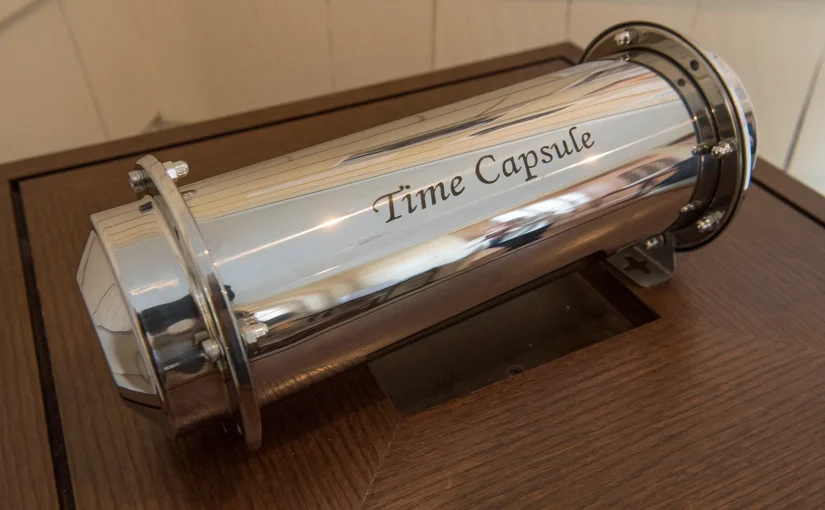

Frozen in Time: Warning of Climate Change

In Atwood’s text “Time Capsule Found on the Dead Planet,” she uses genre conventions to indicate her critiques of contemporary society while warning future generations about the impacts of wealth and climate change. Atwood begins with the creation of gods, numbering this as one and continuing the list as she continues. Atwood’s structure provides the reader with a clear depiction of progression. Beginning with the creation of gods, we are presented with all the goods and prosperity they offer us. In the second age, we are introduced to the creation of money, thus resulting in greed. In this second age, Atwood uses more dystopian literature to depict the catastrophes that soon plagued our society. Atwood critiques contemporary society by using dystopian literature, and the tone in the text drastically changes by the second age. Furthermore, this new amount of mysterious and intriguing wealth could be considered the latest form of “the gods.” People now carried money with them, similar to ancient civilizations when they simultaneously carried their faith and the influence of the gods with them as well. Now, money was their new influence. Money thus became a god as it had power and seemingly was out of control. Finally, in the fourth age, Atwood describes the creation of deserts in which she uses speculative fiction to explore the possibilities of what our world could become if things do not change. The desire for more money and greed have ultimately created these deserts. Even while people face famine and wars, this does not limit the extent to which they are willing to go to gain wealth. Ironically, through the growth of money, we assume that our environment and society would have flourished, yet it has done the exact opposite. Throughout this text, Atwood connects all these creations back to humans, thus the root of the problem: our greed. Too much of one thing that goes unchecked tends to become a negative feature in communities that desire it. The last line, “Pray for us, who once, too, thought we could fly,” distinctively shows the aspirations of humanity that went beyond their capabilities. Therefore, Atwood illustrates the cautions about the consequences of climate change in hopes of discouraging future generations from making the same mistakes.

Atwood’s Time Capsule

After reading “Time Capsule Found on the Dead Planet” by Margaret Atwood, I could better understand the use of genre conventions for rhetorical effect throughout her article. Atwood wrote her piece articulating the idea of humanity in the past and what could happen in the future. An essential aspect of her writing was that she numbered her story as she went on to tell it. This showcases the problems faced as time went on, from the beginning of the gods to money and how it changed the way of life and the environment. Atwood uses genre conventions for rhetorical effect in her article by showcasing the dystopian and dark setting that ultimately shows us that if we do not change how we view the environment and the world, it could lead to problems. In the article, Atwood stated, “In the third age, money became a god. It was all-powerful, and out of control.”. A problem faced in this article that Atwood mentioned was the effect money had on the people and how it ultimately ruined how people acted; the power they had became out of control. Throughout the article, Atwood continuously articulates that there are deeper meanings of the world itself that we are unaware of. Atwood uses a lot of symbolism to showcase a more prevalent meaning. For example, the title uses the words ‘Time Capsule’, which means to store or have information that could be beneficial or not to society, and then the words ‘Found on the Dead Planet’ show that what happened in the past could have affected the future and ultimately gives us the warning to pay more attention to the environment and our actions that we play a role in.