Frozen in Time: Warning of Climate Change

In Atwood’s text “Time Capsule Found on the Dead Planet,” she uses genre conventions to indicate her critiques of contemporary society while warning future generations about the impacts of wealth and climate change. Atwood begins with the creation of gods, numbering this as one and continuing the list as she continues. Atwood’s structure provides the reader with a clear depiction of progression. Beginning with the creation of gods, we are presented with all the goods and prosperity they offer us. In the second age, we are introduced to the creation of money, thus resulting in greed. In this second age, Atwood uses more dystopian literature to depict the catastrophes that soon plagued our society. Atwood critiques contemporary society by using dystopian literature, and the tone in the text drastically changes by the second age. Furthermore, this new amount of mysterious and intriguing wealth could be considered the latest form of “the gods.” People now carried money with them, similar to ancient civilizations when they simultaneously carried their faith and the influence of the gods with them as well. Now, money was their new influence. Money thus became a god as it had power and seemingly was out of control. Finally, in the fourth age, Atwood describes the creation of deserts in which she uses speculative fiction to explore the possibilities of what our world could become if things do not change. The desire for more money and greed have ultimately created these deserts. Even while people face famine and wars, this does not limit the extent to which they are willing to go to gain wealth. Ironically, through the growth of money, we assume that our environment and society would have flourished, yet it has done the exact opposite. Throughout this text, Atwood connects all these creations back to humans, thus the root of the problem: our greed. Too much of one thing that goes unchecked tends to become a negative feature in communities that desire it. The last line, “Pray for us, who once, too, thought we could fly,” distinctively shows the aspirations of humanity that went beyond their capabilities. Therefore, Atwood illustrates the cautions about the consequences of climate change in hopes of discouraging future generations from making the same mistakes.
Atwood’s Time Capsule

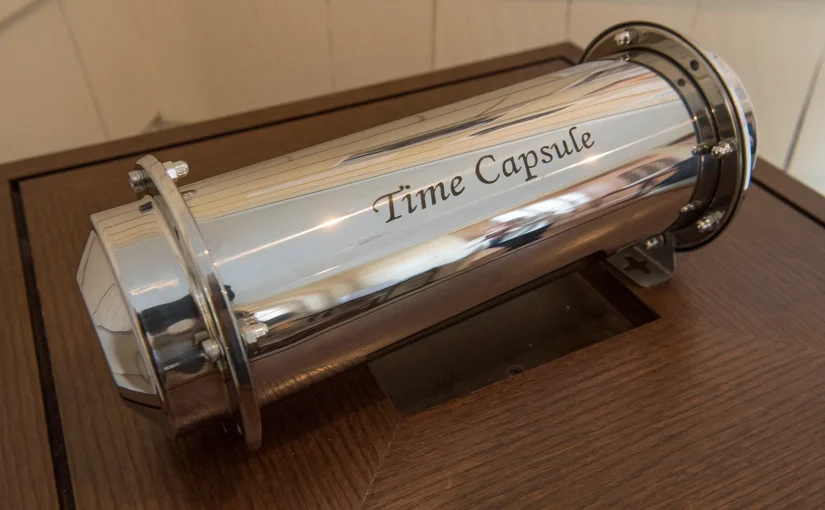
After reading “Time Capsule Found on the Dead Planet” by Margaret Atwood, I could better understand the use of genre conventions for rhetorical effect throughout her article. Atwood wrote her piece articulating the idea of humanity in the past and what could happen in the future. An essential aspect of her writing was that she numbered her story as she went on to tell it. This showcases the problems faced as time went on, from the beginning of the gods to money and how it changed the way of life and the environment. Atwood uses genre conventions for rhetorical effect in her article by showcasing the dystopian and dark setting that ultimately shows us that if we do not change how we view the environment and the world, it could lead to problems. In the article, Atwood stated, “In the third age, money became a god. It was all-powerful, and out of control.”. A problem faced in this article that Atwood mentioned was the effect money had on the people and how it ultimately ruined how people acted; the power they had became out of control. Throughout the article, Atwood continuously articulates that there are deeper meanings of the world itself that we are unaware of. Atwood uses a lot of symbolism to showcase a more prevalent meaning. For example, the title uses the words ‘Time Capsule’, which means to store or have information that could be beneficial or not to society, and then the words ‘Found on the Dead Planet’ show that what happened in the past could have affected the future and ultimately gives us the warning to pay more attention to the environment and our actions that we play a role in.

Navigating the “mobile surround”

New York City is known to be one of the “fastest” cities ever. Everyone has somewhere to be, things to do, and people to meet and they dont have time to waste for smaller things. Being a full-time student and a part-time employee, time is something I wish I had more of. Because of this, I need to already have a plan on where im trying to go and what I need to get done as soon as I get there. When it comes to writing, I need to have access to the internet and sometimes a power outlet if I need to charge my laptop. The best place for me, and im pretty sure for any other Baruch student, is the Baruch library. The library offers internet for students, outlets, even though half of them don’t seem to work. and its quiet most of the time. However, we aren’t allowed to bring outside food or drinks so if I’m on an empty stomach, I would reconsider going here. My secound go-to would be the McDonalds on 23rd street. It does get packed pretty often and can sometimes be noisy, but when its not, it is one of the best places for me to get my writing assignments, or anything else for school. They have a decently stable and fast internet connection, and they offer food and drinks, mainly coffee. They also have outlets in the back of the second floor that anyone can use. If im low on time and its getting late, obviously I would go to my home and work there. I don’t have a desk in my room thats big enough to support having multiple books on it, so I would do most of my work in the dinning room instead. Time isn’t a thing that any of us have to spare, so we have to use it to the best of our abilities.

My Brain as I write

Writing is something I like to do. I like to go into the past, think about stuff that I’d like to write about and write it down on a paper. The environment in which I write in can also depict how well I write. For example, while writing this one of my friends called me to catch up with me and I stopped at “write it down on a paper” for like 30 minutes and completely lost my train of thought. Sometimes, I need to be in my room with some sound like music or someone to talk to, in order to write properly. Other times I need to be in a school environment because at home I feel too lazy, too attracted to my bed to really write. At times, I feel uncomfortable doing work in my house because of how easily distracted I am so I’d just get to school a little early to do my work.

Technologies effect on my brain

Nicholas Carr explains in “Is Google Making Us Stupid?” some negative effects of technology. He says that he feels as if somebody is tinkering with his brain. I understand the feeling described in the reading, but I personally do not feel the same.

I’ve never been a reader. I would have books, but I just wasn’t interested in them. My mom would tell me not to play games too much, to read a book instead but I felt like “why waste my time reading a book when I can be having fun doing something else?” I just cannot focus on a book. Sometimes, reading a book for class can be engaging, I feel like I’m starting to like a book. I believe that the idea of a book that I like ending eventually is what makes me not want to finish. I would love to read books, but they must have multiple parts to it, like Percy Jackson. I loved Percy Jackson because when I finished the first one, I found out there were like 4 more after, along with 2 movies, so its like the story never had an end. After that series, its like if reading just became boring to me.

Technology’s effect on me – Blog post #2

A writing technology Dennis Baron discussed in From Pencils to Pixels is the computer. The computer allows people of all ages to write easier. I believe that using a computer, I am able to write alot better than I can when I am writing on a paper. On a computer, I am simply typing my thoughts, whereas on paper, I have to constantly click my pen/pencil to make sure I am actually writing, along with erasing or crossing out mistakes. Also, when I write a lot, my hands tend to hurt and sweat alot and I don’t like that.

Using a computer to write is not only more convenient for me, but it also allows me to do research as I write. Sometimes while writing a paper in high school, I’d forget how to spell a word, or forget the definition of a word. My high school was very strict on the no phone rule, so I’d have to just find something else to write instead. Using a computer to write, however, allows me to search up a definition of a word, or type a word in the way I think its spelt, and Google will give me the definition of the word, along with an example on how the word is used, and also correct my spelling.
